What Makes a GREAT Competition Driver’s School? The Good, The Bad and The Ugly!
The following information is only intended to serve as a guideline to assist those who wish to achieve a Full Competition License by attending a Driver’s School.
It is not intended to address HPDE/E (High Performance Driver Education) events where students are taught to drive fast and safely in street cars.
IF you would like a hard copy of this in e-book form, send us a message.

There are at least 20+ different paths to achieve a Competition License, so choosing which one is right for YOU might be among the hardest decisions you will ever make. Picking which car and class you want to race in is also difficult, but at least you have some background information and knowledge. Perhaps you daily drive the car you plan to race, or better yet, you have friends who have raced many different types of cars and classes and can provide some un-biased advice. And that is where choosing a Competition Driver's School is different. It is highly unlikely you know a racer friend who has experience with multiple Driver’s Schools. In the end you have to make a critical decision that will form the foundation of your whole driving career, with a very narrow set of information and feedback < that’s what makes it so hard.
Who are We?
Where did our Experience Come From?
Full Disclosure: Grass Paddock Motorsports provides
HPDE and Race Car Rentals nationwide, including to Driver’s Schools
However, we also have close to 50 years of competition experience
More than 100 race car rental clients - that's a ton of 3rd party info
Close to 500 races and over 1000 events

General experience is important, but to advise on Driver’s Schools we need to have specific information – how did we gain that?
I started racing at a time when track days didn’t exist and earning a competition license was pretty difficult. It required attending 2 different schools at different tracks, and there were roughly half the tracks available that we have today. I did SCCA Schools at Summit Point and Charlotte back in the 80s – so yeah, I am THAT old. Please don't hold it against me.
In the 90s I served as an instructor at several different schools with multiple clubs and sanctioning bodies.
Because of our on-track success, there have been many years of private coaching.
While I started renting cars in the early 90s, that business was short lived as family took priority. In 2019 I formed GPM with the goal of helping the next generation get started in motorsports.
The past 6 years of rental experiences have also broadened our knowledge base. Approximately one third of our clients are novices or just starting their racing career and do not yet own a race car. This gives us first hand experience with the skill levels these drivers bring from their varied Comp License path. This third -hand knowledge has been invaluable in putting this guide together
3 years ago we created a FB Group How to get started in Amateur Road Racing | Facebook dedicated to answering people's questions on how to get started in amateur road racing. The questions people asked also helped us understand where the gaps of information were, and what advice was important to provide.
In the end, we have pretty wide-ranging set of experiences which allowed us to put this information together. Are we biased? Probably to some degree – however as a business I am proud we recommend other routes to people more often than we accept people as clients.
1) What is the Right School and Path for me?
Growing up and reading car magazines I used to hate the 10 Best Cars list every publication was famous for making. Either it was too predicated on the journalists’ personal biases, or it was generically aimed at the “average” reader.
Let me be the first to tell you, you are NOT average.

While later in this post there will be some rankings and recommendations, please remember they are based on our opinions and experience, and you might might need to follow a completely unique path based on your own set of circumstances.
One question to ask yourself that may be obvious is :
”Why am I going to a Competition Driver’s School?”
If the answer is “I want to race NOW”, the best solution might be the first available school in your area
If the answer is “I want to be the best race driver I can be”, it might be better to travel to a different school or wait till the right school is available near you.

Another question to ask is “When am I available to attend a school?”. Most club schools are available once per year and are typically at the beginning of a race season. That means they happen during the school year which is an issue for many. Professional schools often run multiple events a year. So availability is key, not just for you, but for the path you choose.
Timing is also critical, and its not just based on the time of year, but on the days of the week.
One of the schools we recommend in Texas is the school presented by the MSR-Houston track. Held 4 times a year it is the choice for many people in that part of the country. But there is a downside. The school is held mid-week because the track is used for racing is on the weekends. Most club schools are held on weekends. Many professional schools are held during the week for that exact same reason. if you have a job with little vacation time or a family, attending a school far away in the middle of the week might be a tough sell.

Just remember......................
THERE IS NO WRONG ANSWER – going to ANY School > than not going to a school
2) Where you live LIKELY changes the Results!
I love driving race cars.
My second favorite thing?
Giving other people the chance to drive race cars. What does that look like?
Years of autox and track days but this was his First session in a race car.
Just look at that face!
Yeah, it be like that.

So, the unfortunate reality is, depending on where you live, and how free you are to travel, you may not have the luxury of choosing between different schools.

The BEST School is ALWAYS whichever one you can attend!
3) What is your Budget?
This is a terrible question, but we cannot ignore it because of how many people start the process and immediately see this as a road block. So let’s discuss why we think it’s a bad question.
First, if the question is “What’s the cheapest way to go racing?” the answer is NOT getting a Competition License. In many ways Competition Licenses are luxuries that open new avenues in racing. One of our goals at GPM is the democratization of motorsports - making this "secret" hobby accessible to the every-person. We are not the only ones.
Thanks to the 24Hours of Lemons folks, the democratization of road racing started with their series of $500 crap boxes driven by people with just a valid State Driver’s License. It has certainly grown from there, and other sanctioning bodies have joined them with a more serious approach to the competition aspect. LuckyDog and ChampCar hold multiple events each year around the country, and even the SCCA has joined the NO COMP LICENSE NEEDED race option with their CRE Program (Club Racing Experience).

To find events around the country that DO NOT REQUIRE a Full Competition License or a list of all known Driver’s School go to www.theracingportal.com and click the Comp License Filter “0 NONE State DL Only”


Second, racing is not, and has never been “cheap”. No matter what any old timer tells you about the days of $25 entry fees, based on CPI adjusted inflation calculations, racing has always taken a fairly large chuck of a person’s salary considering for most it is just a hobby. Even if the car is cheap and you can make it reliable, the unexpected can blow a budget in a split second. Ask me how I know.........................

Finally, the cost of achieving a Full Competition License is fairly consistent, no matter the path, when the different options are compared on a like-to-like basis.
Are pro schools expensive? Yes – but they often provide the car and once you compare a club school + race car rental to a Pro school, it looks pretty similar.
Are schools that end in Full Comp License more expensive than those that end in a Novice or Provisional License? Yes, but if you add the races you have to complete to level-up to a Full Comp License suddenly it’s an equivalent amount.
Are licenses that are awarded based on track experience like a graduated HPDE path less expensive? Again, once you add the costs to attend all those events its turns out to be fairly similar.
Certainly, the least expensive path forward will be if you have your own car - but we have some advice there later in this article.
By the way, if you need a good list of Professional race Schools to consider, we don't provider that here. Why?
Professional schools are for-profit businesses..... they can do their own marketing.
The SCCA does however, have a nice list which you can find here. https://www.scca.com/pages/driver-s-school-w-table
4) Where do You want to Race?
This is not necessarily a location question. There are more than 100 different Comp Schools held in the US annually. Before deciding which one you want to attend, its likely better to decide where you want to race, aka which one of the 50+ sanctioning bodies.
Sprint Races or Endurance?
Modern cars or Vintage?
Limited modifications or wide-open rule sets?
Brand specific? not every sanctioning body has a place for every car
How fast you want to go? Very fast and slow classes are limited
How many people you want to race against? Many classes are regional and others may only have one local competitor
A future blog post will cover What Sanctioning Body/Class is Right for Me?

Most racers start with one sanctioning body. Many spend their whole lives ONLY racing with them. They make friends there, their car is designed specifically for a class that only that Club or Organization runs, or their local track only sees one or two sanctioning bodies use it.
In general, if you know where you want to race, you should follow their suggested path to achieving a Competition License. You cannot expect an east coast sanctioning body to accept a west coast club’s completed Driver’s School certificate if they have never heard of that club.
That said, when asked, we always recommend the SCCA path. Why? The SCCA Full Competition License is the gold standard and is accepted in more of the 50 Sanctioning bodies than any other license.
What about Pro Schools? Depending on the sanctioning body, even those that accept completed certificates from Pro Schools put drivers on a provisional or probationary period.
5) Why are Club Schools the Best?
Before you send a ton of hate our way for this section, #6 is Why are PRO schools the best, so read them both. And 7 and 8 too to understand what they DON'T do well.
THEN send the hate…………
Not every club school is the same, that’s why we will list the different aspects of a school and provide some feedback on each from our experiences.
A)The School Process
When a club runs their own Driver’s School, the benefits exceed the ontrack part of the training. Three things stick out:
The Registration process:
Let’s be real for a minute, you will learn about this eventually no matter where you race. It is just a nice small comfort attending your first race and not having anxiety about how the process works.
The Tech Process: I cannot tell you the number of times a person has arrived for their first SCCA race after attending a different school, and did not have the right equipment. Helmets are a great example – there is some consistency between sanctioning bodies but it is NOT exact.
The Weekend Schedule:
Again, the comfort level of attending an event without worrying how things are managed allows you to relax a bit. And the more relaxed you are, the faster you are, and the fewer mistakes you make.

B) Your Peers and Making New Friends
I guarantee you are going to forget something and suddenly need to ask someone to borrow a tool or lend a hand.
The best part of attending your club’s school is that you start the process making those relationships from day 1. I know a lot of people who have attended Pro Schools. I do not know anyone who has made a long term friend at a Pro school. I am 100% sure it happens. It just happens less.
Why? Pro Schools attract a bunch of people for different reasons. Most everyone at a club school is there for the same reason – to race with that club.
In this way a Pro School is transitional, but a Club School gets you started on equal footing with the other novices.

C) Multi Class Racing
Unless you are lucky and in the most popular of classes, your racing career will likely be in multi-class racing (ie cars are on track with you that are not really racing you because they are in a different class)
Multi class racing brings some key differences to what you likely watch on TV. Mainly, it will not be unusual to race with other cars that have significantly different lap times. Ok thanks Captain Obvious. But how those lap times are achieved may not be obvious. Understanding the process of getting lapped may not even happen at a Pro School – if the drivers who attend are all similar skill levels, you may spend a whole weekend never having to deal with a massive difference in closing speed. The first time someone passes you at 30mph more it can be scary.
Green Flag Starts with faster cars behind you – When everyone is racing the same car, the difference at the drop of the flag is likely just related to reaction time. In a true multi class start there are typically cars faster in a straight line and slower in the corner starting behind you.
Managing your mirrors is a skill set that needs to be developed, may as well start from the beginning

D) Car counts
If you are attending a Pro School the amount of cars you interact with may be limited based on when you attend. Since the cost of track rental for club schools needs to be covered by entry fees, Club Schools tend to happen less often to guarantee they have substantially higher car counts.
Trust me, the more different people you race against, the more you learn.

E) Instructors
Good news/bad news/Good news here. The good news is in club schools the instructors really function as a team. The bad news is, since it’s a volunteer position your dedicated instructor likely has multiple students and the quality may vary.
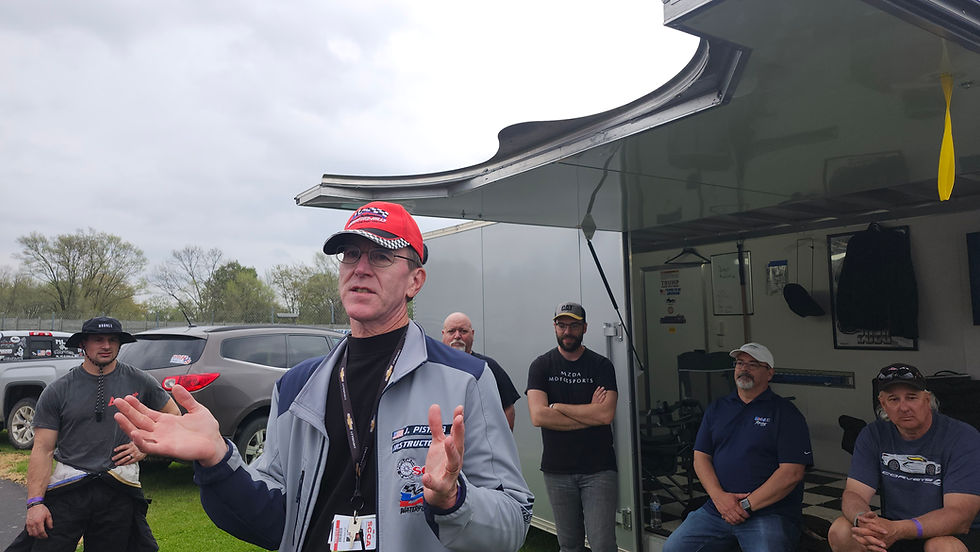
I am going to end on the good news though. The Instructors are amateur racers like you. Many are not far removed from being students themselves so typically they have a better understanding of how a totally green driver feels, and what type of instruction is best to help the student get more comfortable. Some, like in this picture, are national-caliber instructors. Hi Jay!
F) Starts
The majority of Club run schools have many more practice starts than the Pro Schools. Note we are not commenting on actual starts. What makes a practice start different? Purposely mixing up the cars into different grid positions so a driver gets to experience starting up front, in the middle and at the tail end of the fields. When asking novice drivers what makes them the most nervous, its almost always the starts. So doing more of them isa good thing, right?

G) Cost
Club schools are less expensive in the short term (see my comments about long term being roughly the same). If you find out racing is NOT for you – you get out at a lower investment. Much better to decide racing isn't for you after a $500 entry fee than after a $10,000 Pro School. Don't laugh - a percentage of drivers NEVER race after attending a Comp School. And that's a good thing - if its not right for you, there is no shame in not following thru. I would much rather it happens before a race weekend instead of as we race side-by-side into Turn 1.

The final reason a Club School is better has nothing to do with the quality of the School, but the quality of your future race experience.
Club Schools are slowly disappearing, which I think is a bad thing. They provide something different and because there are so many of them, they can all be run differently and the best practices can be absorbed by the others.

I provide this as an analogy, and I am sure you have different ones that match including your favorite little independent restaurant.
My local big box hardware store provides more options at a better price than my small local independent hardware store. I still go to the small store for several reasons, including the fact there is typically a knowledgeable person available to help me answer specific questions. Don’t ask somebody at a big box store which plumbing elbow they recommend – trust me
So in the end , a TIE always should go to a Club School.
If you have a reason to go to a Pro School, do it.
But if you can’t find real justification, or are unsure which is better for you
Support your local club and help keep the club schools open for future generations.

6) Why are PRO Schools the Best?
OK, you heard me rant about why Club Schools are the best – here is the other side of the coin. To be fair, the answers are much simpler and not so nuanced. Also, they make way more money doing this than I do, so I will let them create their own marketing materials.
A) Instructors
Pro Schools have professional instructors. By and large they are just better. Maybe not for you on a given day – just in general. They do this for a living, they have to be. Club Schools have to rely on volunteers. Bad Instructor? If not enough people volunteer they will be back next year regardless. And you do not want to get stuck with a bad instructor.
B) Quality
It’s a business, if they are bad at it, they go out of business. If enough people complain, they change things to stop the complaints. Club Schools are stuck in their history – we will continue to do it that way because we have always done it that way. We don’t have the time, staff or budget to make wholesale changes.
C) Availability
Pro schools are in more locations and available more times of the year so they fit a myriad of people’s schedules better
D) The Cars
In general, the cars at a Pro School are much nicer and more reliable than the average car at a local club school.
An additional benefit is if one breaks you get a replacement so you can guarantee finishing the weekend.
NOTE! We do not recommend taking your own car to a Driver’s School for a ton of reasons, see #10 - The Things we don't recommend
E) Skills
Generally Club Race Schools teach you how to race, they do not teach you how to be good. The goal is that you are a safe driver they are comfortable with at the end of the weekend.
Pro Schools have the time and staff to teach you actual real world racing skills.
7) Things Club Schools don’t do Well
Enough about the good part, here are some things to consider
A) Club Schools are offered at Limited Time and Places
Not Nationwide
Most Clubs have 1 school a year at the local track – miss it, have a mechanical problem and can’t finish the school – come back next year – no partial credit is given
B) Instructor quality is random
C) Limited to 3 hours of instruction time
D) Don’t teach you how to be fast – concentrate on the basic minimums to be safe
Let’s be fair here – if you want to go fast, a Comp School is not the best place. Private coaching is the best path for those attempting to get up to speed the fastest way possible.
8) Things PRO Schools don’t do Well
A) Expensive – don’t get to spread the cost out over time
B )Not Personalized
Are you tall, short or wide? Their car may not fit you
Don’t laugh, I have a list of people who paid for a race school and instead got a ton of instruction in a street car because they did not fit in the car provided. Note that they still received their certificate – but they literally had ZERO experience with green flag race starts in a group of cars
C) Profit Driven
Experiences related by those who have attended. The school spent a ton more time with other students because they had more talent/ more money. It seemed to be a fishing expedition to see if they can convince people to join their race series. This is paraphrasing and not intended to insult anyone – but I have heard this regularly for years, so there is no way its incorrect.
D) Confirmation Bias
I spent more so it MUST be better. I only have 5 people I know who have experienced a Pro School AND a Club School. Not a single one prefers the Pro School Experience. Take that at face value, its just 5 opinions.
9) How do People Learn?
This gets its own topic because this is personal for me. I always took detailed notes in class, because the act of writing something down committed it to memory a whole lot better than reading it 10 times. So it has always made me interested in the process of teaching and learning.
Specifically, if I were to teach you morse code I can do it one of two ways.
All 26 letters and 10 numbers at once
Break it up into segments over different days
The military had this problem. Recruits were always confusing dot-dot-dash-dash-dash and dash-dash-dash-dot-dot (the numbers 2 and 8 for those who don’t know). This could be a terrible mistake when radioing someone a set of bombing coordinates. They (actually my college professor was the guy) figured out that breaking the list up and teaching them on different days resulted in a HUGE reduction in mistakes.

People need a resting period after learning something to allow it to “sink in” so to speak. This is the same reason I tell endurance acers they are slowing their learning process (another one of my many unpopular opinions). If I take two equal novice drivers, and put one in an endurance car for 2 hours straight, and the other gets 4 times 30 minutes sessions, in general the endurance driver will be slower.
So compare that to two popular ways people get Full Competition Licenses
SCCA Club School Path
Driver’s School = 3 hours of instructed track time
Result Novice/Provisional License
Three regional race weekends@ 90 minutes of track time each = 4.5 hours
Result = ability to apply for a Full Competition License
Pro School, 3 or 4 days events
a. Roughly 7.5 hours of instructed track time
b. Result = Certificate to apply for a Full Competition License
WHICH DRIVER WILL BE BETTER after the same 7.5 hours?
10) Things we DO NOT Recommend
AKA THE MOST UNPOPULAR PAGES OF THIS BOOKLET
Before reading our explanation, please understand:
We rent cars for Race Schools so clearly we have a vested interest.
Please keep that in mind when reading our thoughts and advice.
Almost NO ONE we know agrees with us which should probably be a hint
NAH, we feel this way for the reasons cited and are sticking to our guns

OUR RATIONALE:
Your time is valuable, if something happens to the car and you don’t complete the school, there is no partial credit. You have to retake the whole school.
You think there is time between sessions to work on your car – there isn’t. If your school has only 2 groups, they alternate track time. So after getting out you have a debrief with the instructor, time for taking fluids or a potty break, then right back into getting ready to go back out on track.
A crew helps, but is not the final solution. If you own the car they will always defer to your decisions, which adds a distraction.
That distraction is the key – A Driver’s School is the best and cheapest track time you can have + it comes with instructors. Do yourself a favor, rent a car and concentrate on YOURSELF absorbing as much as possible and becoming the best you can be
We have no skin in the game on this next one, just 40 years of experience

OUR RATIONALE:
HPDE/Track Days teach so many good things about driving fast on a race track, unfortunately our experience with the instructors at HPDE, even the certified ones, has not been overwhelmingly positive – that’s not saying there are not good ones, just on average the quality is less.
Track Days teach driving on the line – as a race driver I spend a good portion of my time exploring OFF LINE. Why? The racer in front of me is ON LINE and I need to find a way around him.
Track Days start with lead follow then no-passing laps. This reinforces the habit of focusing on the track in front of you, aka not looking in mirrors enough.
Finally, I quit right-seat coaching when Track Day experience started to become common place. Consider if we rate a novice driver in speed at a 0/10 and race craft at 0/10. After 5 years of HPDE the person comes to a Driver’s School at speed 6/10 and Race Craft still at 0/10. To me that is a more dangerous situation than teaching a 0/10 + 0/10. I speak for MANY instructors when I say, the last thing we want to deal with is a driver who THINKS he is fast from day 1.
11) Things that get BONUS Points
Here are some things we LOVE that happen at SOME Schools
#1 TRACK WALKS
Track walks show detail you CANNOT see from the car. They are one of the MOST valuable things you can do at ANY Race Weekend.

Track walks can ONLY happen at short tracks because daylight track time is expensive. There is no way you are doing a track walk at Road America on a school weekend for example.


VIR is more than 3 miles, Road America is even longer at 4 miles, then more than that, consider the length and elevation changes/hills of The Ozarks circuit.
Waterford Hills is just under 1.5 miles. With instructors stopping to talk, that’s a difference of 1 versus 3 hours.
Schools at Short track bonus:
Trying to learn 7 Turns versus 15, Seeing T1 50 times in a weekend instead of 17.
#2 SIDE-BY-SIDE DRILLS
I mentioned previously how important it is to learn to drive OFF LINE. I am still surprised at the number of tracks that do NOT have this as part of their curriculum.

#3 FIRE DRILLS
Again, not every school includes them. They should be mandatory. I am NOT going to tell you which schools have them and which don’t, because they happen when you least expect it and are super fun to watch the unprepared.

#4 School Format:
For those club schools, some have a Friday/Saturday school schedule and follow up with an official Club Race on Sunday.
These schools are a real TREAT because you get to put what you learned into practice IMMEDIATELY – BONUS! often under the watchful eye of your instructor.
Second, for those sanctioning bodies like the SCCA where you need (3) sign offs before a Full Comp License – you get the 1st in the SAME WEEKEND reducing travel expenses and often with an entry fee special price reduction

12) Our FAVORITE Schools
1 SCCA Roebling February
Bonus Points:
* easy track to learn
* long sight lines –safe track
* format Fri/Sat with Sun race
* 2nd best Instructor set in the country for club school

2 WHRRI/SCCA Waterford Hills April
Bonus Points:
* short track
* good sight lines
* track walk
* Best Instructor set in the
country for club school

3 TIE - SCCA or MCSCC Blackhawk Farms April
Bonus Points:
* medium track
* some good sight lines
* Great Instructor set club school

Before Attending a Comp School, here are 10 QUESTIONS to Ask
Ask Yourself:
How available am I to travel?
What are my short and long term budget restrictions?
How soon do I want this to happen?
Where do I want to race? What type of racing do I want to do?
How do I learn? Quick/Slow? How do I retain things?
Ask the School:
How many people will be taking the school with me/on track at the same time?
What types of people attend this school? What are the background and goals of the people I am attending school with? Similar experience, different goals?
How many hours of Instructed track time will there be?
How many practice starts will there be? How will they be managed? (I’m currently slow, will I always start at the back?)
What is the background and experience of the instructors
Here are some other great pics from schools around the country. Once again thanks to all the workers and volunteers who help this happen.


Comments